
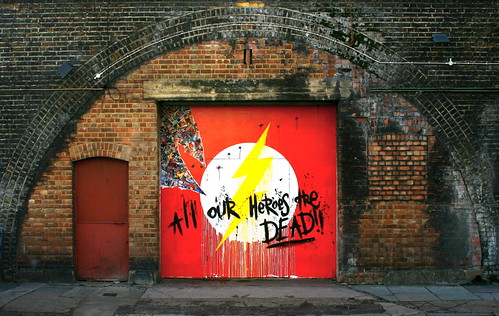
“Should we bestow sainthood on reckless adventurers?” is a great question asked by the Independent. The “hero” / “reckless adventurer” in question is Aron Ralston, who chopped off his arm with a penknife after becoming trapped by a rock in the wilderness. He had not told anyone where he was going.
There are fairly obvious ‘pros’ and ‘cons’ to this argument. What interested me was the Independent’s analysis of whether “adventure” can be heroic or whether it is all tilting at windmills and conquering the useless.
A few snippets from the piece that really got me thinking:
- For some, Ralston is the ultimate all-action hero who hadn’t let fear of death put him off following his instinct for adventure.
- To his admirers, Ralston’s heroic courage lies… in his refusal to let the risks curtail his courting of adventure, the very antithesis of the modern-day affliction of the health and safety culture. He is a five-star example of getting to the very heart of what it means to be human by flamboyantly discarding the layers of protection the rest of us build – or allow to be built – around us.
- Are our heroes vicariously living out what we really want to be doing but are too scared/cowed/busy with our dreary 9 to 5 routines?
- Or they might be the volunteer lifeboatmen who go out 365 days a year, unheralded and largely unthanked, risking their own lives in the seas round Britain to save “idiots” like Ralston who get themselves into tight corners by their derring-do.
- Then there are those whose job can involve the call to heroism – the soldiers, sailors and airmen.
- Perhaps being a selfish bastard helps shapes the circumstances that makes heroes. If you are the sort to feel a duty to go on living for your children, you don’t contemplate climbing K2. Alison Hargreaves died there in 1995, days after being acclaimed a hero as the first woman to reach the summit alone, unsupported and without artificial oxygen. She left two small children without a mother.
- …[We have a] collective habit as a society of focusing narrowly on one well-publicised heroic aspect of an individual, and then applying it to everything else about that individual. Aron Ralston is now top of the pile on the motivational speakers’ circuit. Such presentations usually involve telling the story one more time, and then pretending there is a link between the decision he made to cut his arm off when trapped in an isolated canyon and the decisions that his corporate audiences will be making about where to open the next branch of McDonald’s. Speaker and audience collude in the make-believe that heroism is infectious, and can therefore be caught by contact with a heroic individual, and that it spreads seamlessly between different aspects of that individual’s life.
What do you think?
I think Aron Ralston is an idiot! Crazy story though.
The premiere of 127 hours is tonight – I’m looking forward to it.
The real heroes are the soldiers in Afghanistan. What you do, Alistair, is amazing and inspirational to so many people, but it’s not heroic (no offence!)
Susan
None taken, Susan – I totally agree!
There’s certainly no question of adventurers or expedition leaders being heros, except on the occasions they put themselves in great danger and abandon their plans to save others who have had accidents. It could be argued that both rescued and rescuer have no real need to be there, but if you bring everything in life down to ‘necessities’, there would be no art, no sport and no fun. Pretty dull.
Definitely don’t agree with this, tooling up and calling in air strikes doesn’t constitute heroism in my book. Adventuring yes, heroism no. I don’t make much of a distinction between joining the army and climbing Everest or walking to the North Pole. Both are unnecessary, and needless, but great big adventures.
I think there’s a disconnect between the Fox News definition of hero and the Oxford Dictionary Definition. And the “our boys in Afghanistan” rhetoric is just twoddle.
If Ralston is now a motivational speaker to corporate America, I sincerely hope it is not on the topics of preparation, planning and responsibility.
Don’t be mean, Alex – he’s armless. :-)
As they say, there is a thin line between courage and stupidity. By extension, there is probably also a thin-line between sainthood and a Darwin Award. Personally, I prefer reading about this stuff and setting my sights (and risks) a little lower.
Hi Graeme,
I wrote about that fine line here – https://alastairhumphreys.com/2010/04/fine-line-foolishness-bravery/
I love the Darwin Award analogy!
Everyone is so keen on criticizing one who pays no heed to things such as safety etc. even if its a personal choice that won’t be putting another person at risk.A hero is one who stands up for what he believes in no matter how many enemies he makes in the process or how many walls he has to punch through.Though he can only be a hero in the eyes of someone with a similar mindset/views.
Cheers.
Not sure I agree here. A hero with only a purpose in his/her own head is hardly a hero. Heroes or those who do ‘great’ things have to make a real and tangible positive difference to the world.
In some ways any adventure is reckless. Because by its nature there is some danger or risk involved. You could also argue that it is reckless to undertake an adventure single handed. In the same way you could say any entrepeneurial thing involves risk and so is reckless (so a businessman might risk his home for example). I think what happened to Aron Ralston was a freak accident. He chose to go off and do something on his own (no doubt he should have told people of his plans). But I think sainthood isn’t the right word either. It would be a dull old world if we did everything properly and covered every eventuality. I know there is another question of cost of rescue sometimes (again in terms of risk to other people or financial cost), in Aron’s case he pretty well sorted himself out (if in an extreme manner).
I’ve always thought that the motivational speaking thing is a bit unfortunate. Basically some really impressive individuals going to inspire mostly a bunch of quite dull corporate individuals. I think there should be some some of Adventure Council where people or groups could apply for government funds (yes I know, what government funds?) for their projects. Might sound far fetched. But why would it be so different from the Arts Council or the Crafts Council where worthy projects are funded from government funding. At least then projects could be properly funded without some of the best people around having to go cap in hand to McDonalds or the like.
Nick,
Your Adventure Council is an excellent idea, though you are right that after 13 years of Labour there’s no money left in the pot ( ;-) )
Do I sense you being a little bit politically provocative there Mr H? Anyway, I firmly believe that all the best adventures are done under a Labour government.
Only in as much as I have enjoyed your increasingly exasperated political tweets in recent weeks!
I’m apolitical when it comes to the British Parties…
Why not apply for an arts council grant? Al’s photos/poetry readings are certainly artistic?
An Adventure Council, Nice Idea. Kind of like what the RGS used to be?
We’re currently working on setting up an Adventure Fountain(similiar idea but not just publicly funded) at the moment, great minds…
err, that should read adventure foundation not fountain.
I completely agree with you. If it weren’t for having to shoot people I would have loved much of what the Army has to offer.
The problem there of course is that the core purpose of the military, particularly the infantry, is to project force, or ‘shoot people’. It would be hard to join the Army for the adventure training benefits and avoid its main effort. The Army without this would be the Boy Scouts.
I would have joined up if it was all adventure training and exotic travel…Sadly killing people at the whim of poloticians I didn’t necessarily vote for, and who’s choices I might not agree with, isn’t for me.
Let us know when your Adventure Foundation springs forth – it sounds really interesting and something that is definitely needed.
I know of a couple of other guys scheming something similar, so perhaps a group get-together / brainstorm might be a good idea?
I’ve just sent you a mail on it.
At the moment our idea is to consolidate, communicate and foster adventure in Ireland. Its early days though, we’re still talking, branding and building the site.
I asked myself the same question a couple of weeks ago watching a video of a guy flying in a wingsuit skimming down a valley.
My thoughts are if you want to do it, do it. 2 caveats/exceptions though.
1/ if you have kids, or family responsabilities, assume your responsabilities and don’t take life threatening risks, its selfish. You don’t pick up the bits.
2/ Don’t drag anyone else in with you that hasn’t made the decision to take the same risk, be that rescue services or people accompanying you.
As for them being heroes, well it does take courage to take big risks. There’s that huge pit in the stomach when you’re about to go off the edge/through that rapid/over that waterfall. You really have to push yourself hard and sometimes even blank out the decision and make yourself do it. But does that make them heroes? I would say that the notion of heroism as well as an optional risk factor implies doing what you do for some nobler cause than self satisfaction. So, probably no.
Have to wait ’til February for 127 hrs here in France. The bloke bringing the film over is probably on strike… Whatever the storyline, the decor in the trailer is stunning.
There’s a big difference between courage and heroism. A veteran of WW1 said
“Courage is doing what you’re afraid to do. There can be no courage unless you’re scared.”
But I don’t think that adventure sports are ever heroic. Gutsy, ballsy, bold, scary, worthwhile, terrifying, enriching, inspiring – yes. But heroic? I don’t think so.
My mate Russ and I have been discussing the film a bit. We both read between the lines in the book “Between a rock and a hard place” and thought Ralston was a bit of an irresponsible berk…on several occasions not just the slot canyon thing.
We wondered if Danny Boyle would portray this in the film. Unlikely, would you sell the rights to your life story under that condition? i think the way Boyle’s played it is that Ralston is a guy going at a million miles a minute until this event makes him take stock of his life & appreciate things a bit more.Guess that means we get to see all …the loopy things he’s done but then he learns from his mistakes so it’s all ok & very noble. ha ha. Some cool looking shots too! Camera down Camelbak tube.. fly bys through a slot canyon.. Evil Dead-esque setting up of climbing gear/Karabiner montages.. like the layered up & sped up vapour trails overhead. He’s even made a watch ticking over from 11:59 to midnight appear high octane!! Should be extreme!!
It’s fairly important as it is very rare for the subject of “adventure” sports to be covered in such a high profile film. except in a very trivial way in things like “XXX” and “vertical limit”. There are some amazing films, “touching the void”, but they have very select market. A big budget holywood film on a situation that can’t avoid ethics (acceptable risk etc) could affect the way 1000s of people view the outdoors and their own chosen sport…hope Boyle doesnae ruin it!!
it made us wonder if we should expect a run of ‘adventure’ sport movies. Imagine if Psychovertical became a movie!! Rodriguez to direct please!!
“Adventure Sports” and the ethics thereof – if that is what the film tackles then I shall be watching eagerly (and perhaps a little uncomfortably).
As for Pschovertical the Movie – surely not! Brad Pitt as lead role…?
Life or death? Telling the tale with one arm, or six feet under with both? Survival instinct kicks in sooner or later. Obviously the given example is unimaginably extreme, but the ‘hero’ label is a bit much. I think the man simply did what 3.5 billion years of evolution made sure he’d do. (And it must have been hell.)
The last point in your article is an interesting one. There is something to be said for harnessing a source of inspiration, whether it be a motivational speaker spinning a 30 minute tale of grabbing life by the balls, or sticking on your favourite drum ‘n’ bass LP (works better IMHO!). What that inspiration is applied to is another question. The exaggerations in the quote are a bit cynical though.
I agree. Of all our evolved instincts, survival is top dog. But he might easily have died if not for a) having a leatherman b) being creative in finding solutions to his problem and c) being very persistent. Another person might have simply not been able to cope with the intense fear of the situation.
WIth regards to heroism, what about the the search parties that looked for Ralston, the helicopter crew who whizzed him to hospital, the surgeons who sorted out a bodge-job amputation, the nurses and ocupational therapists, the people who design prosphetic limbs (so he could recalaim the sports he loves); all these people, who go about helping people and saving lives everyday, are only likely to get a passing mention in the film. In my mind they are the truer heros.
When I was just a little guy, heros appeared on the big screen and saved people’s lives. So to my mind, a hero is one that uses bravery, courage and compassion to save lives.
I have often heard of dead people, living in cubicles everyday and coming home just to sit on the couch and watch TV. Living dead people. I suppose if the crazy acts of adventurers awaken the souls of these living dead to go do something and truly live, than they are actually saving lives. I also suppose it’s what’s in their hearts that makes them a hero or not. Is the adventurer motivated by waking up these deadwalkers or is he just motivated by the rush he gets by living on the edge…
I don’t know about sainthood or heroism, but people love a good story. As an author and speaker yourself you obviously know that :)
And whether or not it’s something that people want to emulate, cutting off ones own arm definitely is something people are curious about (would guess that people may want to hear all about it _because_ they don’t want to do it, not in spite of).
I think the concept of a national adventure council is a good one. I don’t see a big difference between this and investing in innovation and technology. Often the potential benefits are hard to see upfront but history teaches us that it’s the unintended benefits that often turn out to be the greatest.
The definition of hero can be described as one who in the face of danger, adversity, weakness displays courage and the will of self-sacrifice, for the greater good of mankind……so does Ralston qualify in worthy merit for the title of hero? On one hand/arm! he does….he has had the courage to define and forge a path for his own free-spirited adventure which in its truest form engenders a sense of courage against adversity. This excites and inspires the average person to a world which sadly is moving to a place of process, safety, rules and where true creativity and adventure is frowned upon. Only having people like Ralston determined to disrupt this format will we continue to move forward as a nation of free thinkers and we should celebrate this.
Conversely his actions I’m sure were purely self-motivated and not planned as a route to progress the greater good of mankind so in its truest sense “hero” should be reserved for those who display those courageous and unselfish acts of which there are many unsung…..perhaps we should find them?
I think you need to ask “would you be happy if your children exhibited this bahaviour”. If you say yes, then they would be hero’s. Now, going on an adventure without telling anyone and then needing to go through extreme measures to save yourself doesn’t make you a hero … it makes you a candidate for a Darwin award!
I think that the hero factor as described here is more attributable to the visceral nature of the succinct movie tagline: “Man chops off his own arm to save his life”. When you have such a compelling and digestible nugget of a story, the rest of the details are irrelevant. They’re not irrelevant to Al’s legitimate (and I think interesting) question, but to the psychology of people who hear the tagline. It’s almost as if it hits all the points in Chip & Dan Heath’s book, “Made to Stick”. I’d challenge any ad creative to write a better line on purpose… Ralston “lucked” into it.
The moment people visualize themselves stranded with their arm stuck under a rock, all perspective is thrown out the window. It’s emotion (a cocktail of sympathy and fear) from there on out.
I think a hero needs someone to be a hero to. Saving yourself is a good idea, smart and sometimes hard but I never think of getting myself out of a scrape as being heroic. Now- a real hero.. is someone like Sir Ernest Shackleton- that guy kept his men alive on sea ice through the arctic winter and got everyone of them safely home- HERO